

Fannie Farmer was a pioneer of modern American cooking and revolutionized the culinary world with her dedication to precision and scientific principles in cooking.
Early Life and Education
Fannie Merritt Farmer was born on March 23, 1857, in Boston, Massachusetts. She was the eldest of four daughters in a family that highly valued education. Her father, John Franklin Farmer, was an editor and printer, and her mother, Mary Watson Merritt Farmer, was a homemaker. The family moved to Medford, Massachusetts, during Fannie's childhood.
Farmer's early education was interrupted by a paralytic stroke at the age of 16, which left her bedridden for several years2. Despite her physical limitations, she developed a keen interest in cooking while helping her mother run a boarding house3. Encouraged by her family and friends, she eventually enrolled in the Boston Cooking School in her early thirties.
Career and Contributions
Farmer graduated from the Boston Cooking School in 1889 and quickly became one of its top students. She stayed on as an assistant to the director and, in 1891, took over as the school's principal. During her tenure, she emphasized the importance of precise measurements and scientific principles in cooking, which was a departure from the traditional, more intuitive methods of the time.
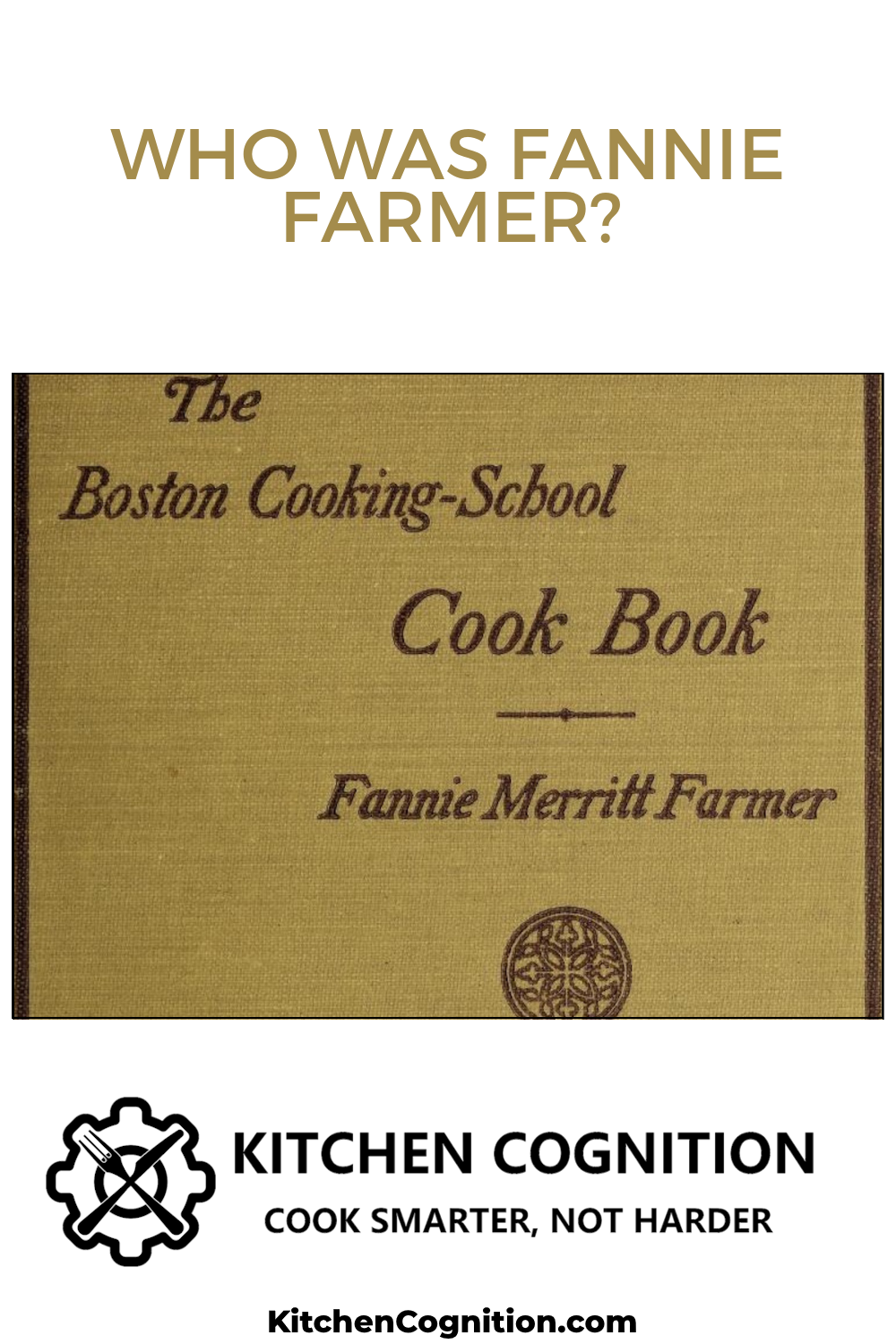
In 1896, Farmer published her most famous work, "The Boston Cooking-School Cook Book". This book introduced standardized measurements and detailed instructions, making it accessible to both novice and experienced cooks. The book was a huge success and is still in print today, often referred to simply as the "Fannie Farmer Cookbook".
Later Life and Legacy
In 1902, Farmer left the Boston Cooking School to establish her own institution, Miss Farmer's School of Cookery. Her new school focused on teaching practical cooking skills to housewives rather than professional chefs. She also conducted a course in dietetic and invalid cooking at Harvard University, highlighting her interest in the nutritional aspects of food.
Farmer continued to write and lecture on cooking and nutrition until her death on January 15, 1915. Her other notable works include "Chafing Dish Possibilities" (1898), "Food and Cookery for the Sick and Convalescent" (1904), and "What to Have for Dinner" (1905).
Fannie Farmer's contributions to the culinary world are immense. She is credited with popularizing the use of standardized measurements in recipes, which has become a fundamental aspect of modern cooking. Her emphasis on scientific principles and nutrition has had a lasting impact on the way we approach food and cooking today.
Conclusion
Fannie Farmer's legacy lives on through her cookbooks and the countless cooks and chefs she has inspired. Her pioneering work in standardizing measurements and promoting scientific cooking methods has made her a true icon in the culinary world. Whether you're a professional chef or a home cook, Fannie Farmer's influence is evident in every recipe you follow and every dish you create.
Sources and More Info:
- Britannica: Fannie Farmer
- Encyclopedia of World Biography: Fannie Farmer Biography
- Smithsonian Libraries: The Boston cooking-school cook book
Comments